 Logistics
 Manufacturing
 Retail
 Healthcare
 Office
 Multifunctionals and Printers
 Barcode and Label Printers
 Barcode Solutions
 Software Solutions
 Digital Signage
 Barcode Printer Ribbons
 Managed Document Services
 Global Business Solutions
 Our Company
 Sustainability
 Security
 Career
 News
News
 Blog
Blog
 Business Partner Search
 Contact us
Is Your Label Printing Setup Keeping Up with Your Operations?
Labels may be inconspicuous, but they play a big role in keeping operations moving.
From production lines and warehouses to retail supply chains and healthcare environments, labels help products, assets and information get to the right place at the right time. If labelling runs smoothly, it often goes unnoticed. However, when it doesn’t, it can quickly lead to major problems or even a production shutdown.
Production can slow down, errors may increase and teams are often taken away from more important work to solve issues that should be routine. Despite this, many industrial printing environments remain shaped by systems that have not evolved in line with the realities of modern-day working environments.
As operations become faster, more connected and more complex, labelling needs to keep up.
Why Industrial Printing Needs a Rethink
Industrial printing is often treated as a background process. But in many environments, it sits right at the centre of daily workflows.
Labelling requirements are becoming more demanding. Businesses are handling higher volumes, tighter compliance requirements, evolving IT needs and more sites to manage. At the same time, many print environments still depend on legacy printers, rigid software setups and processes that are difficult to change once they are in place.
This can create unnecessary complexity. It can also make it harder to upgrade devices, improve efficiency or introduce automation without disrupting day-to-day operations.
So, what should a modern industrial printing setup deliver?
It should be flexible, reliable and easy to integrate. It should support existing workflows rather than forcing businesses to redesign them. It should also help reduce downtime, control costs and give teams more confidence in their labelling processes.
What Holds Industrial Labelling Back?
The challenges behind industrial printing often build up gradually. Over time, workarounds become normal and inefficiencies become part of everyday operations.
Common issues include reliance on external labelling software, difficulty replacing or upgrading printers, downtime caused by consumable changes and limited visibility when managing printer fleets across multiple locations.
Individually, these problems may seem manageable. Together, they can reduce productivity, increase costs and make it harder for businesses to adapt as their needs change.
This is why the right printing platform matters.
How Does Toshiba’s BX Series Help?
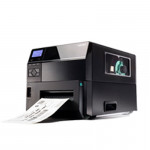
Toshiba developed the BX Series industrial printers to help businesses modernise their labelling without adding unnecessary disruption.
Built on Toshiba’s A-BRID platform, the BX Series is designed to work as an intelligent and connected part of the wider business environment. Rather than forcing operations to adapt around the printer, the printer can adapt to existing systems and workflows.
This makes it easier to update industrial printing infrastructure while maintaining continuity across daily operations.
Less Complexity at the Point of Printing
One of the most practical benefits of the A-BRID platform is direct PDF printing.
BX Series printers can print PDFs natively, automatically scaling and rotating content without the need for additional labelling software or a dedicated workstation. For many organisations, this removes a layer of complexity from industrial printing and reduces reliance on specialist tools.
The BX Series also supports auto-emulation and print data conversion.This means the printer can recognise and adapt to different printer languages automatically and even modify print data on-the-fly, making it easier to replace or upgrade legacy devices without redesigning existing workflows.
In practice, businesses can continue using existing systems and data formats, reduce disruption during upgrade projects and deploy new printers more efficiently across multiple sites.
To see these capabilities in action and understand how they can support real-world environments, watch our short overview videos.
Where Do the Long-Term Savings Come From?
The cost of industrial printing is not limited to the hardware itself.
Consumables, maintenance and downtime all affect the long-term cost of running a print environment, especially in high-volume or continuous operation settings. Small interruptions can quickly add up.
The BX Series is designed to help reduce these pressures. Long-life print heads, optional ribbon saving technology and intelligent features such as near-end detection help improve consumable efficiency and reduce unnecessary intervention.
This supports more predictable total cost of ownership, fewer interruptions to production and greater reliability over extended periods.
Ready for Smarter Labelling?
Rethinking industrial printing is not about changing technology for the sake of it. It is about making labelling simpler, more reliable and easier to manage as your business evolves.
With robust industrial hardware and an intelligent, flexible platform, Toshiba’s BX Series helps turn printing from a potential bottleneck into a dependable part of everyday operations.
To find out more about Toshiba’s BX Series industrial printers, download the brochure or contact our team to discuss your industrial printing and labelling requirements.